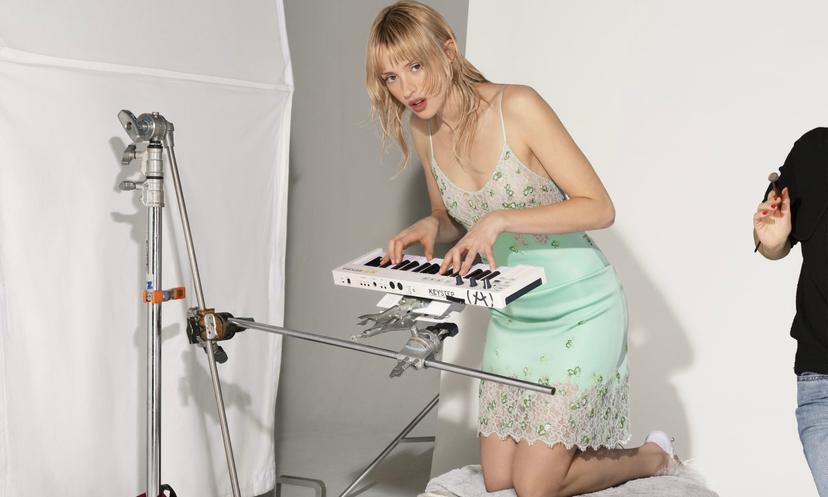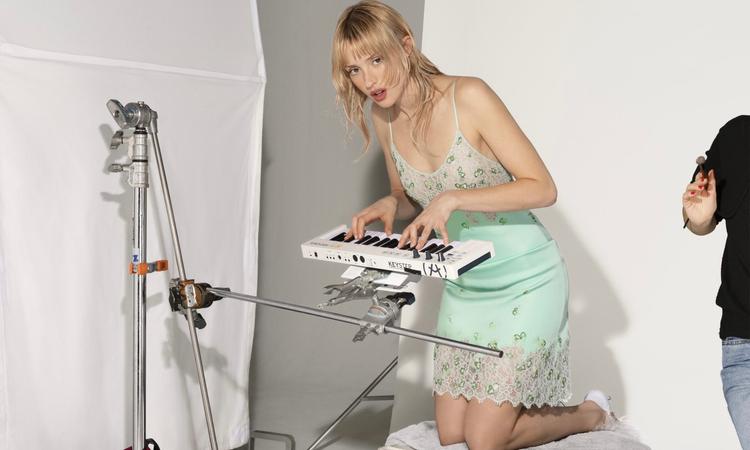
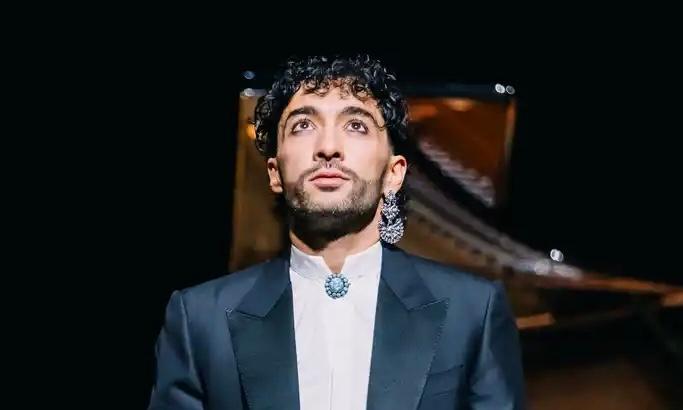
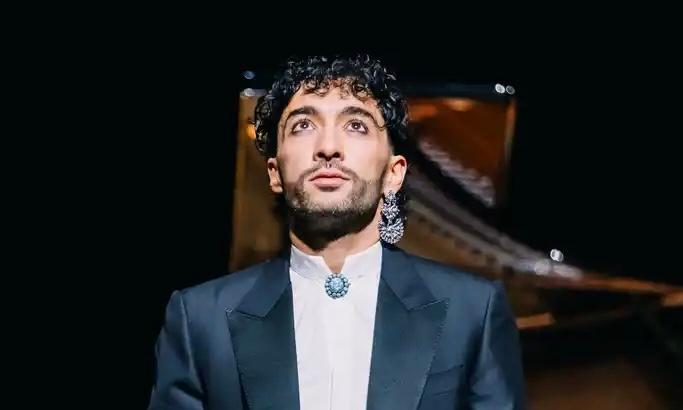
His burning piano set the Paris 2024 Olympic Games opening ceremony ablaze as he accompanied Juliette Armanet on Lennon’s Imagine. Since then, Sofiane Pamart has settled in the hills of West Hollywood, where he composed Movie, an album conceived like a film in the California light. We met the French pianist at the Deauville American Film Festival, where he spoke about his new life in the United States before returning to California and preparing for his next challenge: taking on the Stade de France solo on April 17, 2027. Interview by Anaïs Maquiné Denecker.
Read the original interview in French here.
Le Petit Journal: You now live in the hills above Los Angeles. Why did you choose this city?
Sofiane Pamart: I’ve always loved cinema, but I also like to associate each of my creative cycles with a particular place. I’ve traveled extensively to compose: Asia for my album Planet, then South America for Noche. For this fourth album, I wanted to create a work conceived as a film. I asked myself where the best place to do that would be, and Hollywood was the obvious choice. I hadn’t decided in advance that it would be the United States; cinema is what naturally led me here. My idea was to attempt an album imagined as an arthouse film with a blockbuster budget.
Le Petit Journal: In Los Angeles, nature and light seem to have become instruments in your music. How does a landscape turn into sound?
Sofiane Pamart: Where I live, near Runyon Canyon, I feel as though I’m surrounded by nature. Sitting at my piano, I feel like I’m in some kind of control tower. I watch birds of prey flying overhead and see the light changing throughout the day. An artist’s role is to capture whatever they find beautiful or moving around them and then transform it through their medium. Mine is the piano. Everything I experience becomes music.
Le Petit Journal: A Frenchman living in Los Angeles, an album called Movie, and now Deauville and its American Film Festival. The invitation to open the ceremony at the piano almost seemed inevitable…
Sofiane Pamart: The invitation is very closely connected to my latest album, which I composed in Hollywood. The connection between a pianist living in the capital of cinema, an album paying tribute to it, and a festival devoted to American cinema was fairly obvious. Everything seemed to echo everything else.
Le Petit Journal: You describe Movie as a film without images. What is its dramatic arc?
Sofiane Pamart: I composed it like a soundtrack, but also as a film in its own right — a day in the life of Los Angeles. The opening scene, Sunrise In Your Eyes, is a sunrise; the final one, Your Eyes On Sunset, is a sunset. I imagined a day divided into as many sequences as there are tracks, during which we experience the full range of emotions that make up life.
Le Petit Journal: A philharmonic orchestra, fourteen international guests and twenty tracks: how do you maintain a sense of unity in such an ambitious project?
Sofiane Pamart: It was the first time I had composed for an orchestra of around seventy musicians. I imagined each featured artist as an actor, including Sia, Wyclef Jean, Christine and the Queens, and basketball player Jimmy Butler as the narrator. There are a lot of ingredients, but the piano remains the common thread. My first reward was simply being able to bring the work to life exactly as I had imagined it.
Le Petit Journal: You wanted to preserve the movie playing inside each listener’s mind. Could you nevertheless imagine entrusting Movie to a director one day?
Sofiane Pamart: At first, I didn’t want to. The whole concept was precisely for everyone to create their own images. I didn’t want to confine the album to one particular visual interpretation. But I’m starting to have second thoughts… Perhaps, several years from now, having a great director reinterpret Movie could be something incredible.
Le Petit Journal: Living in Los Angeles puts you at the heart of the film industry. Are these encounters beginning to open up new possibilities?
Sofiane Pamart: I met Ethan Hawke here in Deauville, and Quentin Tarantino in Cannes. But I never approach those encounters hoping to get something from them. Sometimes the most valuable thing someone can give me is a few words that build my confidence and that I’ll carry with me for the rest of my life. Ethan Hawke told me that when you achieve excellence in one field, you become closer to everyone else who has achieved excellence, whatever their world may be. I thought that was very true. Of course, collaborating with either of them would be a tremendous privilege.
Le Petit Journal: You often cite composer John Williams, Steven Spielberg’s longtime collaborator, as your ultimate reference. Would your dream be to score a film, or to build a lasting artistic partnership with a filmmaker?
Sofiane Pamart: I admire John Williams, who still writes his scores in pencil, using a method that never changes. His partnership with Spielberg is incredibly inspiring. In cinema, my greatest dream would be to build that kind of long-term relationship with a great director.
Le Petit Journal: Has Los Angeles become your home base, or is it still another stop along the way in a body of work shaped by travel?
Sofiane Pamart: If I leave this city, it will be difficult because I’ve grown attached to it. But I’m not closing the door on other great journeys. I like the idea of every project opening up a new territory.
Le Petit Journal: Your rise since launching your solo career in 2019 seems meteoric. And yet it is built on many years of preparation and a path far removed from traditional music industry circles…
Sofiane Pamart: I understood very early on that I wanted to be an artist and that I had things to say through the piano. There were at least fifteen invisible years of preparation, reflection and experimentation. I grew up in Hellemmes, in northern France, in a family of non-musicians. Then the piano came into our lives. My relationship with life remains very simple, very grounded in ordinary people, but I express it through this instrument. I think a lot of people in my audience probably see themselves in that.
Le Petit Journal: From winning a gold medal at the Lille Conservatory to entering the world of rap, you have challenged the boundaries traditionally imposed on the piano. Was that a way of bringing the instrument back into popular culture?
Sofiane Pamart: My ambition is to offer something very elegant to the widest possible audience and to give popular culture access to excellence. I reject the idea that one form of culture should be reserved for a handful of people while another is intended for everyone else. The piano was brought into a home where there had never been one; the last thing I want is for my piano to be exclusionary. My mission is to create a movement around it that brings people together.
Le Petit Journal: In April 2027, you will become the first pianist to take on the Stade de France solo. How do you reconcile the intimacy of the piano with the sheer scale of a stadium?
Sofiane Pamart: It’s an immense challenge and an honor. That date will make history because it has never been done before. There is no model I can compare myself to. I have to invent something. My goal is to bring the same level of elegance to the Stade de France as I would to the Palais Garnier, creating a show that is both sophisticated and monumental. I want the sound of the piano to reach the person in the front row just as powerfully as the person sitting at the very back. I’m thinking about film, stage design and storytelling to make the show immersive. I think like a director. I define what I want to say before choosing the actors.
Le Petit Journal: At the Paris Olympics, your burning piano and Juliette Armanet’s voice performing Imagine created one of the defining images of the opening ceremony. How did that moment change the course of your career?
Sofiane Pamart: The Olympics opened new doors for me internationally, and I feel that very strongly in Los Angeles. It was a completely crazy project, prepared in secret for two and a half years. Even my mother wasn’t allowed to know about it. Being part of something so huge and historic was extraordinary for me. Those are once-in-a-lifetime moments.
Le Petit Journal: After Paris 2024, Los Angeles 2028 almost seems written in the stars. Is that something you’re already thinking about?
Sofiane Pamart: I can’t talk about it…
Sur le même sujet

 L'agenda