
At 88, Ridley Scott sends Jacob Elordi and an old Cessna to face the end of the world. Shot in Italy, this $110 million blockbuster revisits the apocalypse—but does it with undeniable style. In theaters in France on August 26 and in the United States on August 28. A review by Claude Budin-Juteau.
Read the original version in French here.
The title comes from Peter Heller’s 2012 novel of the same name, an international bestseller. The “Dog Star” is Sirius, the brightest star in the night sky. In both the book and the film, Hig, a solitary pilot, gazes up at the heavens and invents his own constellations, naming them after the people he has lost. Ridley Scott even plays with the idea that one celestial configuration might bear the name of his own dog, Jasper.
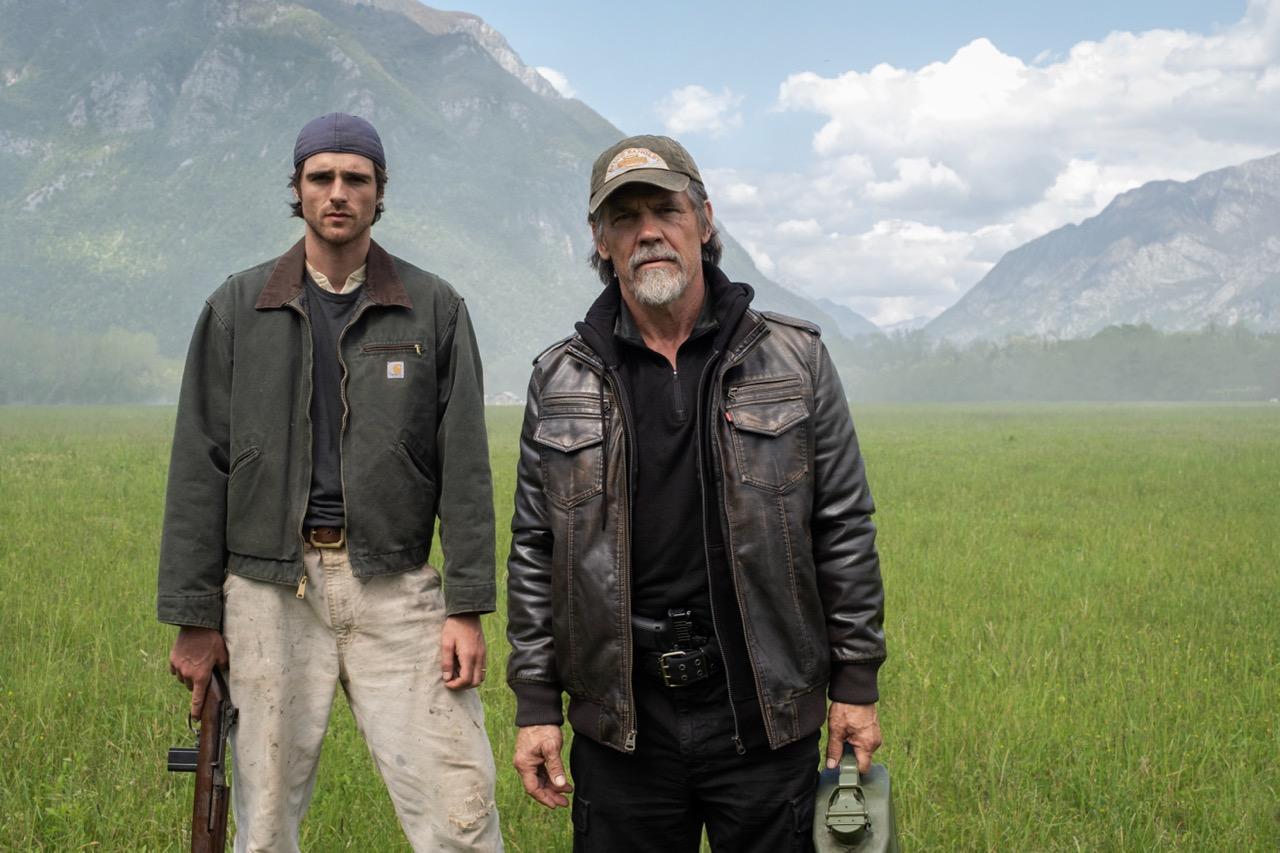
The story: a pandemic has wiped humanity off the map. Hig (Jacob Elordi) survives in an abandoned hangar in Colorado with Bangley (Josh Brolin), a taciturn former Marine, and Jasper, his dog. A mysterious radio transmission prompts him to fly into the unknown, eventually taking him to Grand Junction, where he encounters Pops (Guy Pearce) and his daughter Cima (Margaret Qualley), who rekindle his hope that humanity might still have a future. One detail only adds to the charm: Hig’s plane is a 1956 Cessna, lending this devastated world a retro-futuristic quality tinged with old-fashioned nostalgia.
With a budget of $110 million, the production set up its cameras in the Italian Dolomites, which make a convincing stand-in for the Rocky Mountains, before moving to Rome’s Cinecittà Studios—the largest film studio in Europe and the place where Fellini shot much of his work. Two cinematic legends, one set: the circle is complete.
True to form, Scott shoots “in 360 degrees,” using six to eleven cameras simultaneously and sparing his actors the grind of endless takes. The method nearly sent Josh Brolin running on the very first day of filming, before he became a complete convert. The unmistakable touch of the director behind Alien, Blade Runner and Gladiator is everywhere, his appetite for sweeping landscapes and spectacular filmmaking as strong as ever.
The cast delivers: Elordi plays Hig as haunted and quietly withdrawn, Brolin gives Bangley a gruff, Lee Marvin-like edge, Qualley brings warmth and light to Cima, while Pearce embodies a wary patriarch. Special mention goes to Jasper, who is actually played by three identical dogs—one for cuddling, one for posing and one for attacking.
The film’s message? A subtle ode to humanity’s stubborn determination to rebuild, even among the ruins. Shot in IMAX, some sequences are breathtakingly beautiful. The theme itself is hardly new: the post-apocalyptic world has been explored countless times before. But in Scott’s hands, scenes such as the Reapers’ attack or the arrival in Grand Junction veer—without giving too much away—into an almost surreal kind of fantasy.
It is enough to transform an all-too-familiar premise into something distinctly personal: a film somewhere between the raw energy of Mad Max and the quiet intimacy of a campfire beneath the stars.
C.B.-J.
Sur le même sujet







 L'agenda