Four decades after the first “Man” went up in flames, set alight by a couple dozen eccentric hippies on a San Francisco beach, Burning Man 2026 — which ended this Sunday, September 7 — is searching for ways to reinvent itself in Nevada’s Black Rock Desert. A report by our special correspondent, Samuel Bitoun.
Read the original article in French here.
It is an ephemeral city, rising out of nowhere for a week of artistic, social and communal experimentation, where spirituality vies with paganism in its rawest form. Burning Man has become a global cultural phenomenon, but also a logistical machine on a scale rarely seen — and one that is not without its share of failures.
A City of 70,000 rises from the desert
Black Rock City, located 125 miles northeast of Reno, Nevada, now stretches across more than 15 square kilometers, crisscrossed by 110 kilometers of temporary roads, powered by thousands of generators and organized around 1,500 camps devoted to an astonishing variety of interests.
Here, cannabis enthusiasts; there, some 600 followers of Jesus praying around the clock (Editor’s note: they were forcibly expelled this year for “filming participants without their consent,” according to organizers). Nearby, skydiving naturists leap from planes completely naked and thoroughly tanned — with red backsides awaiting those who failed to protect themselves from the Sun God.
Further on, beneath the Orgy Dome — a vast, 500-square-meter air-conditioned tent illuminated by pink and red neon lights to set the mood — adventurous couples gather to enjoy the pleasures of the flesh “au naturel,” on dozens of mattresses laid directly on the ground, from dusk till dawn and dawn till dusk, alone, as couples, throuples or in any number of other combinations, provided everyone is so inclined.
No one here is judged, nor does anyone judge others, and the word “freedom” is on everyone’s lips and minds. For the space of a week, the America gathered here in this vast libertine playground allows itself every excess, as though a heavy lid had suddenly been lifted — if only for ten days — in the middle of this hostile desert.
A lucrative business
The organization’s overall budget, estimated at between $55 million and $65 million, reflects the gradual commercial industrialization of a gathering that nevertheless prides itself on being non-commercial and built around sharing — while recruiting an army of volunteer lawyers each year to contain its problems.
The “average” admission ticket this year costs between $550 and $3,000 per person, plus $165 per vehicle. The budget required simply to “survive” on site can approach $5,000, $8,000 or even more, depending on your preferences: eating sand or sleeping in an air-conditioned RV — and don’t forget your earplugs if you would rather not be lulled to sleep by deafening sound systems competing to reach ever more outrageous decibel levels.
What began as a large, festive, egalitarian gathering has become an ephemeral micro-society that eagerly reproduces the very rituals and social castes it once sought to dismantle. John Law, one of the festival’s founders, now condemns the event’s excesses, comparing it to a “Disneyland for wealthy hipsters” and even contemplating its eventual disappearance.
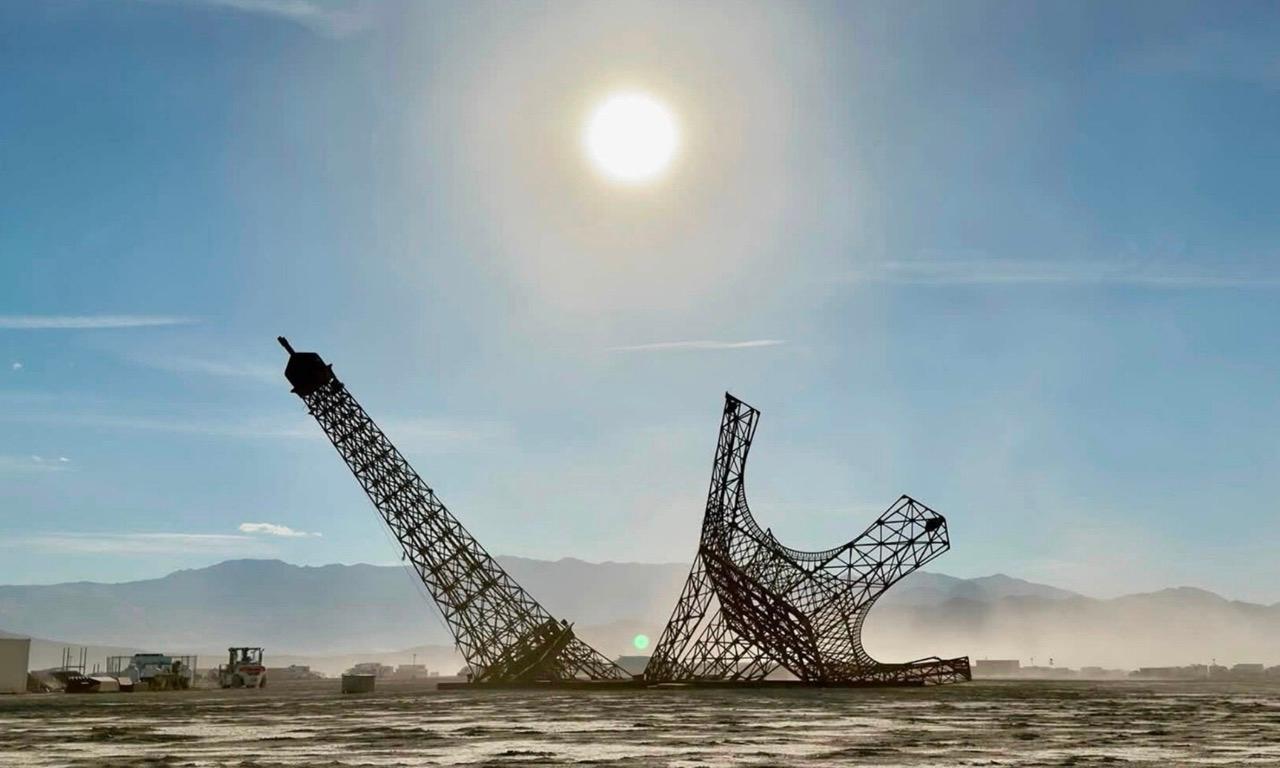
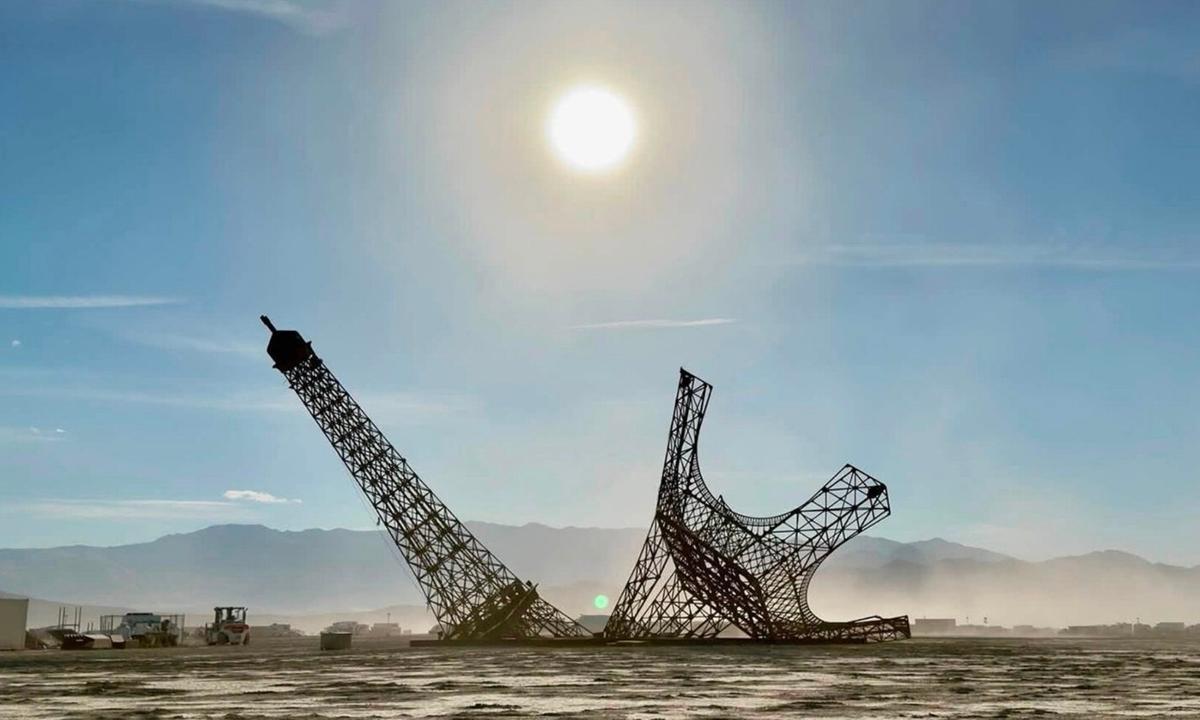
This year, around 350 art installations were erected within days amid this immense organized chaos, including some 30 monumental structures. Among them was a 29-ton Eiffel Tower, broken in two, which traveled from France’s Vendée region in four shipping containers before taking its place among striking modern sculptures and more modest creations. The cost of the Eiffela Broken Dream project: nearly €300,000.
Other curiosities included the “mutant vehicles,” transformed into mobile sculptures covered in flashy LED lights, roaming the city day and night, while nearly 1,200 volunteer Rangers helped ensure the safety of a community that prides itself on self-governance.
A constant Public Health challenge
Behind the image of an unfettered, hyper-sensualized and proudly radical festival, many participants spend considerable time under the influence of psychoactive substances. Burning Man therefore cannot escape earthly and material realities and must operate what amounts to a genuine emergency medical infrastructure.
At the heart of the system is the temporary Rampart hospital, with 70 beds and 150 healthcare professionals carrying out between 250 and 300 interventions every day. It is equipped for basic imaging, minor surgery and stabilization of serious cases.
Four additional medical stations handle minor injuries, respiratory infections and dehydration — the most common problem in an environment where temperatures hovered between 100°F and 109°F throughout the week and humidity fell below 10%.
Statistics from previous editions recorded between 3,000 and 4,000 cases of dehydration each year, 1,200 to 1,500 respiratory infections linked to alkaline dust, 2,500 to 3,000 miscellaneous injuries and, most notably, 300 to 500 cases of overdose-related poisoning, including 20 to 40 serious cases.
Medical evacuations are frequent: each year, around 450 people are transported out by road and another 15 to 25 by helicopter from a temporary airfield set up south of the main camp.
Safety: A city forced to manage its own crises and contradictions
Although Burning Man insists there are no spectators and promotes the “total” participation of its members, keeping them safe remains a major challenge.
The Rangers respond to between 3,500 and 4,000 incidents per edition, mainly involving interpersonal conflicts, risky behavior or accidents related to nighttime traffic. Arrests are also as much a reality here as they are in the outside world.
Since 1986, the festival has not been spared tragedy, with an officially acknowledged death toll of around 60 people. This year, two deaths were confirmed: one participant suffered a fatal heart attack, while another died in an accident involving an art car.
A major economic impact for Nevada
Beyond the artistic and communal experience, Burning Man represents a major economic windfall for the state of Nevada. Its direct economic impact is estimated at between $75 million and $90 million, while indirect benefits — including accommodations, transportation and local purchases — reach between $150 million and $200 million.
Nearly 3,000 temporary jobs are generated each year, while Washoe and Pershing counties collect between $8 million and $12 million in taxes and various fees.
A utopia under intense pressure
Forty years after its birth, Burning Man remains, for some, a unique social laboratory — a space for artistic and human experimentation unlike anywhere else, yet one that must reinvent itself or risk eventually being crushed under its own weight.
For others, this temple of Sodom and Gomorrah represents the shame of modern America and will, sooner or later, perish in some gigantic earthquake — a Dantean echo of divine wrath yet to come. The festival’s “survivalists” certainly experienced nature’s fury this year, as torrential rain battered the temporary city for several hours on Friday, trapping everyone in the mud and rendering roads impassable until they dried. Authorities sought to prevent a repeat of last year’s chaos, when torrential rain accompanied by violent winds stranded thousands of participants for many hours.
This year, the event’s carbon footprint is also estimated at more than 100,000 metric tons of CO₂ — enough to bring its environmentally minded participants firmly back down to earth. This massive overcrowding is therefore destabilizing an event that has become almost uncontrollable, caught somewhere between radical community experiment and mega-festival — and it may ultimately prove to be the reason for its demise...
S.B.
 L'agenda